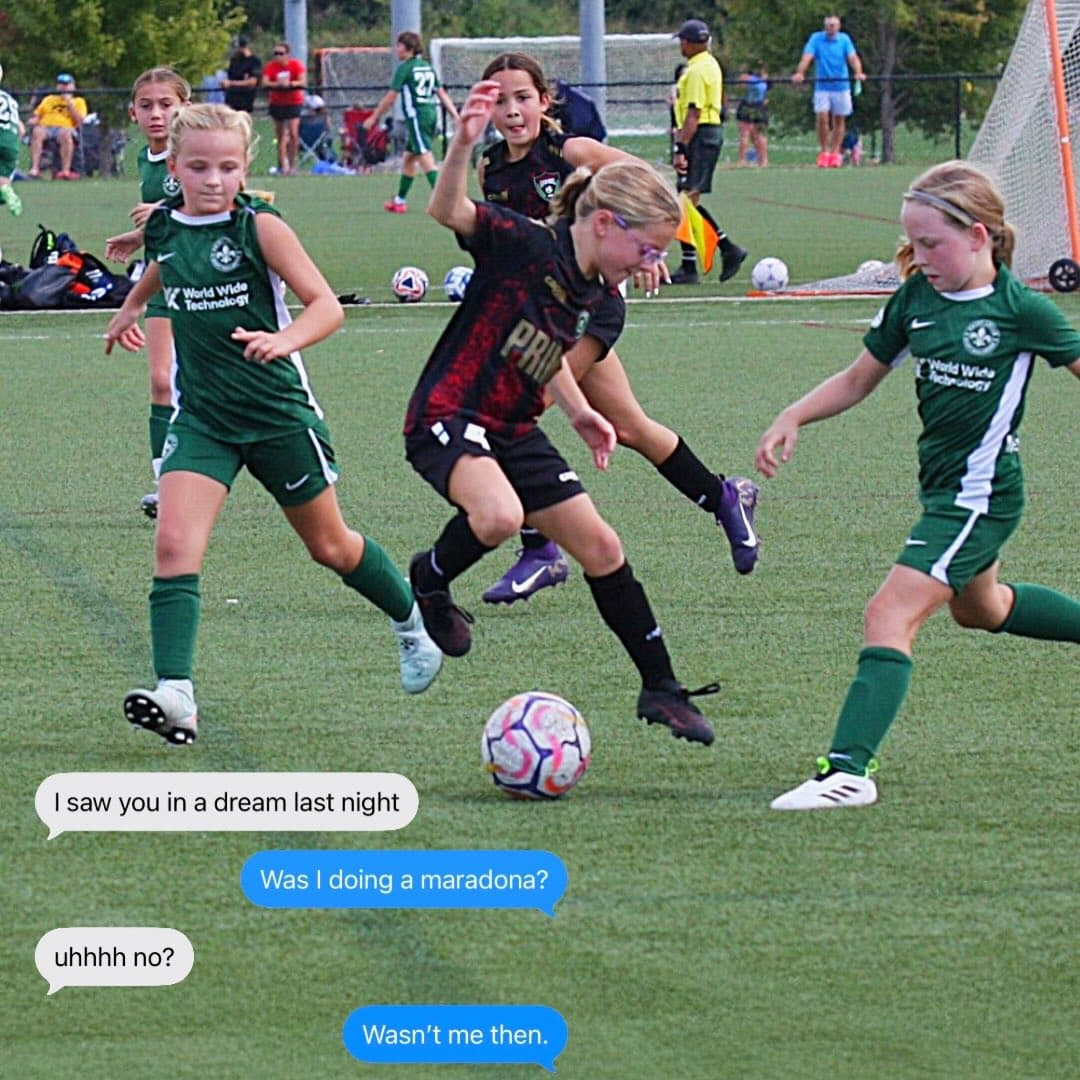
Relentlessly Forward: Why We Celebrate Mistakes on the Goal Line
At KC Legends, we eliminated backwards and sideways passing for developing players — and we actually celebrate failed dribbling attempts on our own goal line. Here's why embracing risk builds the unstoppable self-belief young athletes need.
Most youth soccer coaches would bench a player who attempts a 270-degree Maradona Turn on their own goal line.
At KC Legends, we congratulate them.
The Problem with Playing Safe
We refuse to teach our players to play it safe. Here is why: safe plays are fearful plays.
When a young player receives the ball near their own goal and immediately boots it downfield, what are they actually communicating? They are saying: I am afraid. I do not trust my skill. I need this ball as far away from me as possible.
That clearance might relieve the immediate pressure. But it teaches the player nothing except that fear is an acceptable response to a difficult situation. Multiply that lesson across hundreds of games and thousands of moments, and you produce a player — and eventually a person — who reflexively avoids difficulty rather than engaging with it.
Eliminating Backwards and Sideways
In our curriculum, we have eliminated backwards and sideways passing for our developing players.
This is not a minor philosophical preference. It is a core training principle that shapes everything we do.
We want our players attacking their immediate opponent like waves crashing on the shore — relentlessly, persistently, creatively. Forward is the only direction. The defender in front of you is not an obstacle to avoid — they are a challenge to embrace.
This means our players will lose the ball more often than players in programs that prioritize safe distribution. They will give up goals that could have been prevented by a simple clearance. They will make mistakes that make parents wince from the sideline.
And that is exactly the point.
The Goal Line Test
Here is the ultimate expression of our philosophy: we actually celebrate and congratulate players who attempt incredibly difficult moves — like a 270-degree Maradona Turn — on their own goal line.
Think about what that means. The player is in the most dangerous possible position on the field. A mistake here does not just lose possession — it directly gives the opponent a scoring opportunity. Every instinct, every conventional coaching voice, every nervous parent on the sideline is screaming: clear it, get rid of it, play it safe.
And our player attempts a Maradona Turn.
Why? Because taking the risk of losing the ball in the ultimate "Danger Area" takes immense guts, personality, and courage.
That player is not being reckless. They are being brave. There is a critical difference that most coaches fail to understand.
Reckless is attempting something without the skill to execute it. Brave is attempting something difficult because you have trained the skill and you trust your ability under pressure. Our players train these moves thousands of times. When they attempt them in the danger area, they are applying practiced skill in the highest-pressure environment possible.
Fear and Growth Cannot Coexist
The science of peak performance tells us something that traditional youth coaches consistently ignore: you cannot develop mastery while operating from a state of fear.
When a player is afraid of making a mistake — afraid of the coach's reaction, afraid of the parent's disappointment, afraid of the opponent scoring — their brain shifts into a defensive mode that actively inhibits creativity, risk-taking, and technical execution. The neural pathways for precise motor control literally narrow under fear-based stress.
This is why the safest-playing teams often look technically competent in low-pressure situations but fall apart in big games. Their players have been trained to avoid mistakes, not to perform under pressure. The moment the pressure exceeds their comfort zone, they have no tools to respond.
Our players are different because we systematically train them to face fear, not avoid it. Every time a player attempts a creative move in the danger area and survives — whether the move succeeds or fails — they expand their comfort zone. The next high-pressure moment feels slightly less threatening. Over time, they develop the capacity to perform their best when the stakes are highest.
Building Unstoppable Self-Belief
By encouraging our players to face their fears and risk failure in practice, we build the unstoppable self-belief they need to perform minor miracles during high-pressure games.
Self-belief is not built by succeeding at easy things. It is built by attempting difficult things, surviving the failures, and discovering that failure is neither permanent nor catastrophic. Every failed Maradona Turn on the goal line that is met with encouragement rather than punishment teaches the player: it is safe to try. It is safe to risk. I can handle the consequences.
That lesson compounds over years. By the time our players reach the competitive level — college showcases, high-pressure tournament games, moments that define seasons — they have a reservoir of courage that players from fear-based programs simply do not possess.
They have been in the danger area. They have attempted the difficult move. They have failed, recovered, and tried again. And they know, from hundreds of lived experiences, that they are capable of performing under pressure because they have been doing it since they were seven years old.
The Waves on the Shore
We tell our players to attack like waves crashing on the shore. Waves do not hesitate. They do not calculate risk. They do not play it safe. They move relentlessly forward because that is what they are.
We want our players to internalize that same quality — not as blind aggression, but as trained courage. The confidence to take the ball forward in any situation, against any opponent, in any area of the pitch. The self-belief to attempt the creative solution when the conventional solution is easier. The courage to own the moment rather than passing it to someone else.
Relentlessly forward. That is how Legends play.
Frequently Asked Questions
How do you build confidence in a fearful youth athlete?
Confidence is built by creating a training environment where risk-taking is celebrated and mistakes are treated as learning opportunities, not failures. At KC Legends, we encourage players to attempt difficult moves in high-pressure situations — including on their own goal line — and congratulate the attempt regardless of the outcome. Over time, this builds genuine self-belief that transfers to games and life.
Why would a coach encourage risky plays near the player's own goal?
Attempting a creative move in the most dangerous area of the field requires immense courage and trust in one's training. By celebrating these attempts, we teach players that bravery is more valuable than safety, and that their skills are reliable even under maximum pressure. The goal-line dribble is the ultimate test of confidence.
Does playing aggressively forward cause teams to lose more games?
In the short term, yes — our developing teams may concede goals that a clearance would have prevented. But in the long term, players who are trained to attack relentlessly develop the confidence, creativity, and pressure resistance that makes them far more effective competitors. The short-term losses produce long-term winners.
What is the difference between reckless play and brave play in youth soccer?
Reckless play is attempting something without the skill to execute it. Brave play is attempting something difficult because you have trained the skill and trust your ability under pressure. KC Legends players train creative moves thousands of times, so when they attempt them in high-pressure situations, they are applying practiced skill courageously — not gambling blindly.
Topics