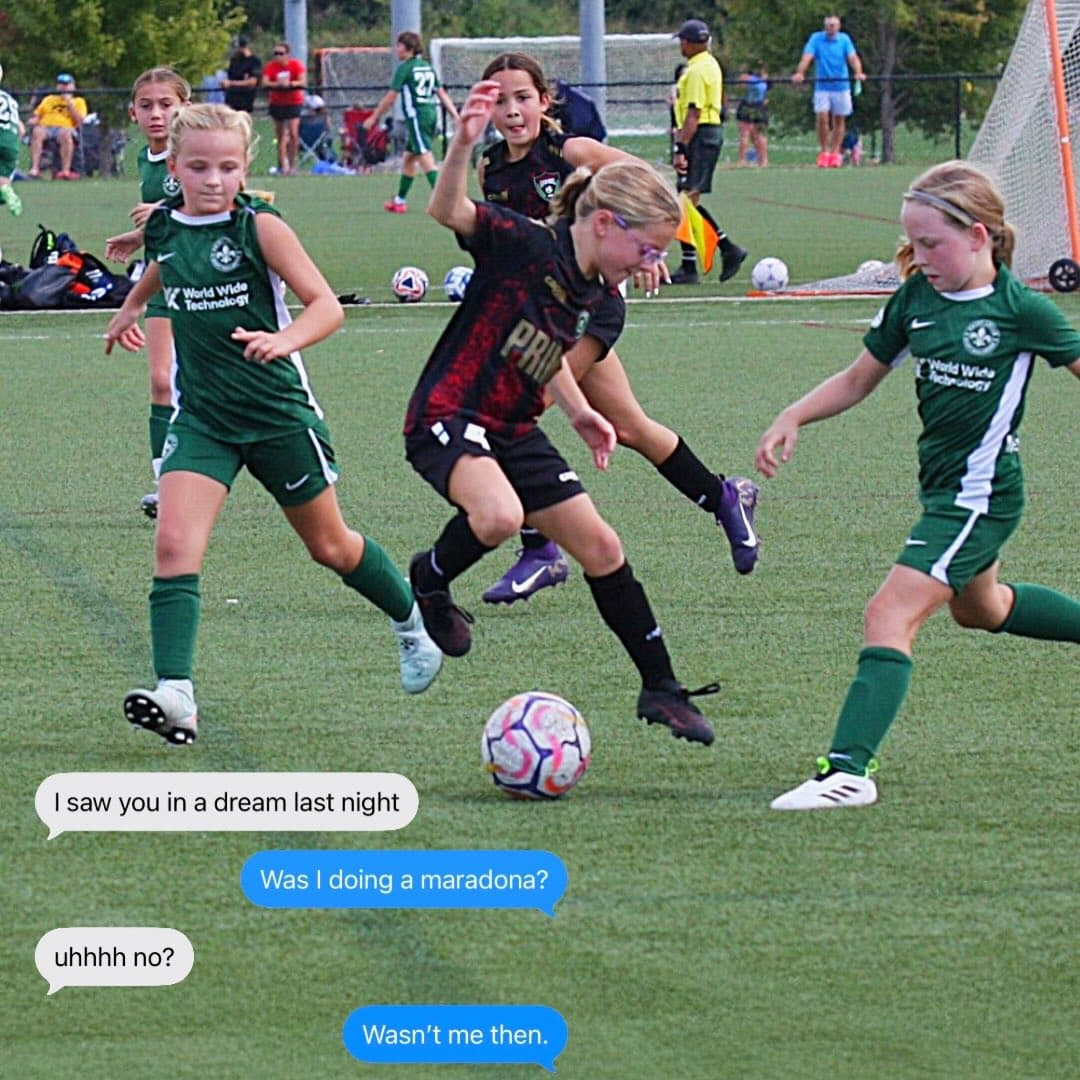
Why Creative Dribbling Matters More Than Passing for Young Players
Most youth soccer coaches rush to teach passing. Andy Barney explains why 35 years of evidence shows creative dribbling should come first — and why KC Legends players develop faster because of it.
Every season, I meet parents who have watched their child's previous coach split training time evenly between dribbling, passing, and positioning. The logic sounds reasonable: soccer involves all of those things, so why not teach all of them?
Here is why: splitting early training time dilutes the one skill that determines whether a player ever develops real confidence on the ball.
After 35 years of coaching youth soccer, I have seen what happens when programs rush to teach passing before players have genuine dribbling ability. They produce players who are comfortable giving the ball away and uncomfortable holding it. Those players look fine in structured drills. They fall apart when a defender closes them down and there is no open teammate in sight.
The Easy Way Out
The core problem is human nature. When a child has the ball at her feet and a defender approaching, she has two options: attempt a creative move and take responsibility for the outcome, or pass the ball to a teammate and transfer that responsibility.
"Unless the emphasis is 100% on dribbling and finishing, the player will take the easy way out and give the ball — and the responsibility — to a teammate instead of trying the fake or taking the shot."
The pass is always easier. It is faster, lower-risk, and socially acceptable — teammates rarely complain when you pass to them. Attempting a dribble and getting dispossessed, on the other hand, is visible and uncomfortable. Children will choose the comfortable option unless the training environment makes the brave option the expectation.
That is exactly what we build at KC Legends. We train dribbling and finishing first, and we train them at 100% emphasis until the skill is genuinely internalized. Passing comes later — on top of a technical foundation that makes it meaningful.
The Courage to Take Responsibility
This is deeper than technique. "In soccer, as in life, it is far easier to give away — or refuse to take — responsibility."
When a young player consistently chooses to pass rather than dribble, she is practicing the habit of transferring responsibility. That habit does not stay on the soccer pitch. It follows her into the classroom, the office, and every team she will ever be part of.
We want to build the opposite habit. A player who routinely attempts creative dribbles — in front of teammates, coaches, and parents — is practicing the act of owning the moment. Over hundreds of repetitions across a season, that becomes who she is. The courage to carry the ball becomes the courage to carry responsibility.
Technical Perfection Trumps Speed
One of the principles we return to constantly in Legends training is this: technical perfection trumps speed.
Parents sometimes watch our sessions and ask why we slow things down, why we isolate the touch before the move, why we do not push players to execute at full pace immediately. The answer is that speed built on imprecise technique is fragile. It breaks down under game pressure. Technical precision built into muscle memory through repetition is durable — it holds up in tight spaces with defenders closing in.
This is why the 12 Best Moves in the Legends style (detailed in Chapter 75 of the Training Soccer Legends manual) are trained slowly and deliberately before they are trained at pace. We want the movement pattern locked in before we add the variable of speed. Players who master this sequence are capable of executing at full pace in competition because the technique is automatic.
The Passer Needs Legends Training More
Here is the part that surprises most parents: the players who need dribbling training most are often the passers.
A player who relies heavily on passing before she has genuine dribbling confidence is a player who is one good press away from having no solution. When defenders cut off passing lanes, she freezes. She has no individual escape route because she never developed one.
A player who has internalized creative dribbling has options in every situation. She can hold the ball, beat a defender, and then make the pass from a better position. The dribbling skill does not replace passing — it makes passing better.
This is what I mean when I say: great scorers are epic passers, and phenomenal dribblers are marvelous receivers. The skills do not compete with each other. They compound. The player who has earned the right to dribble past defenders attracts more pressure from opponents, which opens more passing lanes for teammates, which makes the team more effective. The individual skill lifts the collective game.
How Skills Compound
Development is not linear. Skills built on top of other skills create exponential progress.
A player who cannot dribble confidently cannot receive effectively under pressure — she has no plan for what to do when the ball arrives and a defender is closing. A player who can dribble confidently can receive with calm because she knows she has a way out. That calm allows her first touch to be better. A better first touch gives her more time. More time allows her to see the field. Seeing the field makes her a better passer and a better decision-maker.
The whole chain starts with dribbling.
At KC Legends, we build that chain deliberately — dribbling first, finishing second, and everything else in sequence. It is a longer route to a complete player, but it is the route that produces players who last. Our 400+ college alumni and $8.8 million in scholarships are the evidence.
Frequently Asked Questions
Should young soccer players focus on dribbling or passing?
At the early development stages, young players should focus primarily on dribbling and finishing. Passing is always available as an option, but without genuine dribbling confidence, players learn to use passing as an escape rather than a tactical choice. Once dribbling is internalized, passing becomes far more effective because the player is choosing to pass rather than defaulting to it.
At what age should kids learn to pass in soccer?
Passing naturally develops alongside dribbling — you cannot fully separate them. But the emphasis on passing as a primary skill should come after a player has real individual confidence with the ball. For most players, this means dribbling and finishing are prioritized through early youth (roughly U6–U10), with passing and combination play introduced with increasing emphasis from U10 onward. Players who try to skip ahead to passing before building individual skill tend to plateau early.
How does dribbling improve overall soccer skills?
Dribbling develops ball control, close-touch precision, spatial awareness, and the confidence to hold the ball under pressure. A player who can dribble attracts more defensive pressure, which opens passing lanes for teammates. She also develops better receiving skills because she is comfortable in tight spaces. Paradoxically, the best way to produce a great passer is to spend significant time developing a great dribbler first.
Want to see what 100% emphasis on dribbling looks like in a training session? Check out our recreational programs or register for tryouts to have your player evaluated.
Learn & Test Yourself
Review the key concepts and test your understanding.
Key Concepts
1 of 5
Question
Why should dribbling be taught before passing in youth soccer?
Tap to reveal answer
Test Your Knowledge
1 of 5
According to KC Legends' philosophy, why do young players default to passing instead of dribbling?
Topics