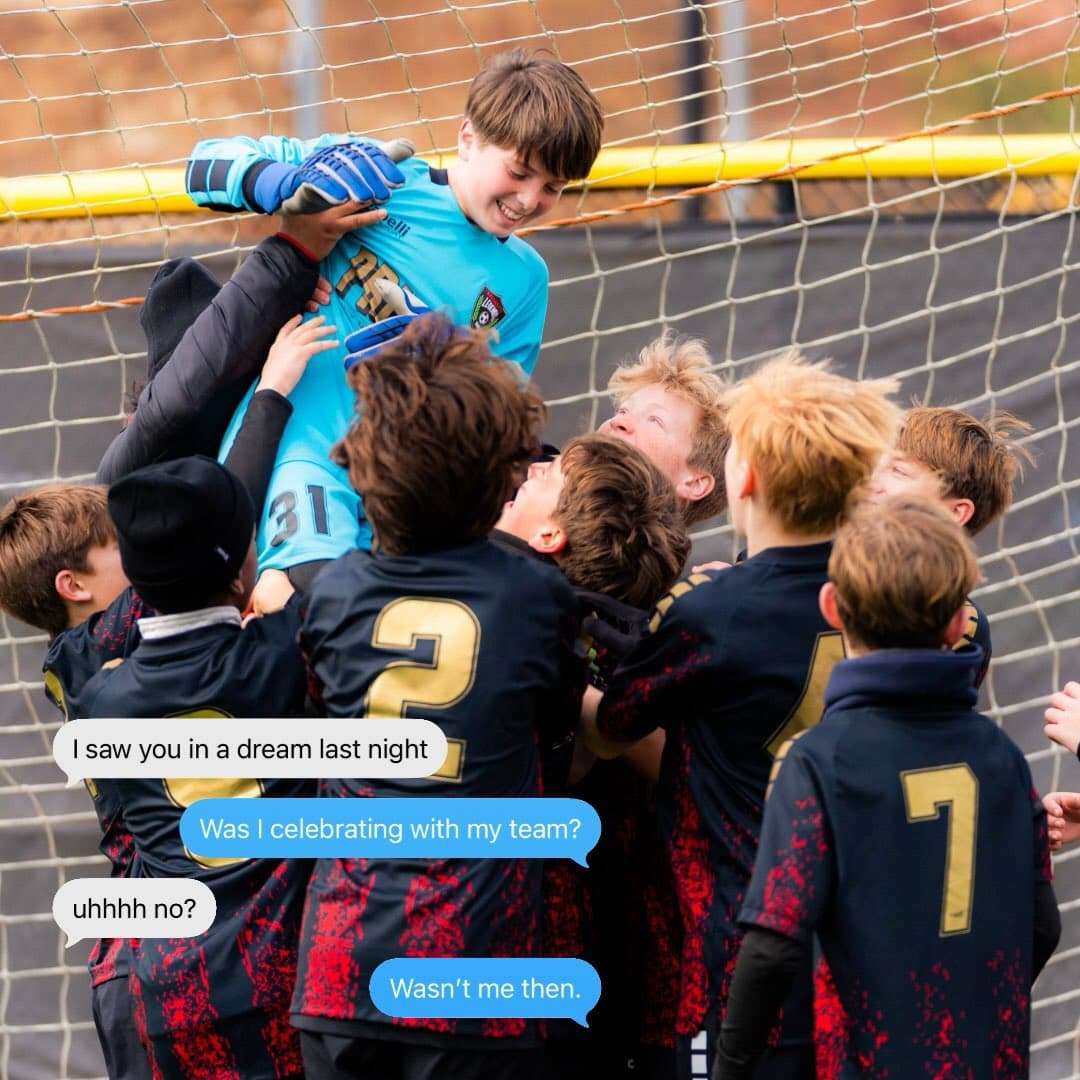
Speed Chess on Grass: Building a Team of Swashbuckling Pirates
Learn how individual-focused soccer development creates unstoppable team play. Discover the 'Zone of Altered Consciousness' where creative individualism transforms into Creative Team Unity and Harmony — the KC Legends approach to building dominant teams.
Parents ask the most important question in youth soccer development more than any other: "If you focus on individual skills, how does that eventually build a winning team?"
It is the right question. And the answer reveals why KC Legends produces teams that do not just win — they dominate in ways that are genuinely difficult for opponents to comprehend.
The Fundamental Truth
A fundamental truth of soccer development is that creative individualism precedes inter-dependence.
Read that again. It is the single most important principle in building a team of brilliance.
You cannot build a brilliant team with players who are individually inadequate and totally dependent on safe, rote-brainwashed passing. A team of players who can only pass is a team of players who collapse the moment a well-organized defense cuts off passing lanes. They have no individual escape route. They have no creativity under pressure. They have dependency masquerading as teamwork.
True team brilliance requires players who first possess individual technical mastery — the ability to hold the ball, beat a defender, and finish under pressure. Only when players have earned that individual capability can genuine inter-dependence emerge.
The Edge of Anarchy
Once our players have mastered individual technical skills through years of creative dribbling and finishing training, something remarkable happens in our sessions. We intentionally push training to the very edge of anarchy.
We introduce what we call "speed chess on grass" — multiple simultaneous 2v2 games with complicating conditions in highly crowded areas. The space is tight. The pressure is constant. There are no structured rotations or predictable patterns. Every decision must be made in fractions of a second.
This is deliberate chaos. And it looks, from the outside, like barely controlled madness.
But here is what is actually happening: players who have spent years developing individual confidence are now being forced to combine that individual skill with awareness of teammates in chaotic, high-pressure environments. They cannot rely on memorized passing patterns because the chaos does not repeat. They must read, react, and create in real time.
The Zone of Altered Consciousness
By pushing players into these chaotic, high-risk environments repeatedly, they eventually enter what we call a "Zone of Altered Consciousness."
This is not a metaphor. Players in this zone experience a genuine shift in perception:
-
Vision expands. Players begin to see passing lanes and defensive gaps that were invisible to them before. The peripheral awareness that comes from surviving chaos at speed opens perceptual channels that structured training cannot access.
-
Motivation transforms. Players stop playing to avoid mistakes and start playing to create beauty. The fear-based motivation of organized soccer — "do not lose the ball, do not make an error" — is replaced by the creative motivation of street soccer: "what can I create in this moment?"
-
Decision speed accelerates. Decisions that once required conscious thought become automatic. The player does not think "I should pass here" or "I should dribble there." She simply acts. The training has moved from conscious competence to unconscious creativity.
Swashbuckling Pirates of the Soccer Field
Players who reach this zone transform into what I call "swashbuckling pirates" of the soccer field. They play with:
- Incredible tactical speed — reading and executing faster than opponents can react
- Unscripted freedom — no reliance on memorized patterns or coach instructions
- Creative audacity — the willingness to attempt the unexpected, the deceptive, the brilliant
- Collective intuition — an almost telepathic understanding of where teammates will be
These players completely confuse and dominate their opponents. Not because they have better formations or more disciplined positioning, but because they are operating at a creative speed that traditional, receive-and-pass teams cannot match. Opponents prepared for structured soccer cannot defend against unstructured brilliance.
Creative Team Unity and Harmony
The end result is what we call "Creative Team Unity and Harmony" — a team of brilliance where the sum of the whole is far greater than its parts.
This is not the manufactured teamwork of synchronized passing drills. It is organic, creative, and deeply resilient. When one player makes an unexpected move, her teammates instinctively adjust — not because they were told to, but because they have developed the individual awareness and tactical speed to read the game in real time.
The paradox is complete: by investing years in individual development, by refusing to rush into team tactics, by trusting that creative individualism must precede inter-dependence, we produce teams that are more unified, more cohesive, and more devastating than any team built on organization alone.
The sum is greater than its parts because each part is genuinely brilliant.
The Development Timeline
This process is not fast. It requires patience from coaches, parents, and players:
-
Foundation (Ages 5-10): 100% emphasis on creative dribbling and finishing. Individual skill development with street soccer principles embedded in every session.
-
Transition (Ages 10-13): Introduction of "speed chess" environments. Small-sided games with increasing complexity. Players begin combining individual skill with awareness of teammates.
-
Integration (Ages 13+): The emphasis gradually switches to the most difficult team concepts: combining deceptive approach play with one- and two-touch passing and finishing. Players now have the individual foundation to execute complex team play at creative speed.
-
Mastery (Ages 15+): Creative Team Unity and Harmony. The Zone of Altered Consciousness becomes the default state. The team operates as a single creative organism.
At each stage, the long-term curriculum drives the progression — not game results, not parent pressure, not short-term thinking.
Frequently Asked Questions
How does an individual-focused soccer program eventually build a winning team?
While the early stages of development heavily emphasize individual risk-taking and can look chaotic, the ultimate goal is Creative Team Unity and Harmony. As players mature and master ball control, the emphasis gradually switches to the most difficult team concepts: combining deceptive approach play with one- and two-touch passing and finishing. Because the players already possess immense individual confidence and tactical speed, they can interact with a level of creative synergy and unscripted freedom that completely confuses and dominates opponents. The sum becomes far greater than its parts.
Why shouldn't young soccer players focus heavily on passing?
Teaching complex passing and abstract off-the-ball patterns to young children is analogous to teaching calculus to first graders. The young mind is simply not psychologically mature enough to conceptualize these three-dimensional soccer patterns. Emphasizing team passing too early leads to frustration and restricts the development of individual flair, creating players who are heavily reliant on their teammates and individually inadequate. Individual technical mastery must come first.
What are the most important soccer skills for beginners to master?
Youth development should focus exclusively on the most difficult individual techniques: deceptive dribbling and finishing. We begin by teaching difficult fakes and shooting techniques as our first priority, rather than starting with simple skills and working our way up. Once a player acquires the technical ability to hold the ball under intense pressure and strike it accurately, passing and support play can be learned in a fraction of the time as they mature.
Why do some cultures produce more creative soccer players?
In North America and Northern Europe, societal conditioning and organized coaching heavily emphasize teamwork, passing, and receiving, which often stifles natural creativity. In contrast, the street soccer cultures of South America and many African nations encourage a more eclectic, creative style of play. Without adult interference focused purely on winning games, these environments allow players to take risks, use their imagination, and focus on individual dribbling — producing players with deeper creativity and confidence.
What is the "Zone of Altered Consciousness" in soccer training?
The Zone of Altered Consciousness is a state players enter after extensive training in chaotic, high-pressure, small-sided environments. In this zone, vision expands, decision-making becomes automatic, and creative execution happens without conscious deliberation. Players move from thinking about what to do to simply doing it — reading the game, teammates, and opponents simultaneously at a speed that structured training alone cannot produce. It is the result of years of individual skill development combined with progressive exposure to creative chaos.
What does "speed chess on grass" mean in soccer?
Speed chess on grass describes KC Legends' approach to advanced team training: multiple simultaneous small-sided games (typically 2v2) played in crowded spaces with complicating conditions. Like chess, every move creates new possibilities and threats. Like speed chess, decisions must be made in fractions of a second. This environment forces players to combine individual technical skill with real-time creative awareness of teammates and opponents — producing the tactical speed and unscripted freedom that defines Creative Team Unity and Harmony.
Ready to see how individual brilliance becomes team dominance? Register for tryouts or learn about the Legends Method.
Topics