The State of Youth Soccer in Kansas City: Trends, Data, and What Parents Should Know
Data-driven look at youth soccer in Kansas City. Participation trends, club landscape, costs, development pathways, and what makes KC different.
Youth soccer in Kansas City is at an inflection point. Participation is strong, infrastructure is world-class, and the pathways from recreational play to college and professional development have never been more clearly defined. But underneath that positive headline, there are real trends — around cost, accessibility, player retention, and how the game is coached — that every KC soccer parent should understand.
This is not a marketing piece. It is a data-informed look at what is actually happening in youth soccer in the Kansas City metro, what the national trends mean locally, and what thoughtful parents should be paying attention to.
The Numbers: Youth Soccer Participation
Nationally: US Soccer reported approximately 3.9 million registered youth players in 2025, making soccer the third most popular youth sport in the United States behind basketball and baseball/softball. That number has been relatively stable over the past five years after a period of growth from 2010-2018.
The deeper story: While total registration numbers are flat, the composition of participation is shifting. According to the Aspen Institute's Project Play, the percentage of children playing organized soccer at least one day per year peaked at about 10% and has held steady. However, the number of children playing three or more sports has declined, and the number specializing in a single sport before age 12 has increased.
In Kansas City: The KC metro is home to an estimated 25,000 to 30,000 registered youth soccer players across recreational and competitive programs. Heartland Soccer Association alone registers over 3,000 teams per season, representing roughly 45,000 to 50,000 individual seasonal player registrations (many players register for both fall and spring).
These are strong numbers. Per capita, Kansas City's youth soccer participation rate is above the national average, driven by strong infrastructure (the Scheels complex is one of the best in the country), a deep club ecosystem, and Sporting KC's visibility as a professional franchise.
The Club Landscape: More Options Than Ever
The Kansas City metro is home to more than 30 youth soccer clubs, ranging from small recreational organizations to nationally competitive programs. This density gives families options but also creates confusion.
Major competitive clubs (partial list):
- Sporting Kansas City Academy (MLS NEXT platform)
- Kansas City Athletics (KCA)
- Dynamos FC
- KC Fusion
- Jayhawks Soccer Club
- FC Wyandotte
- KC Legends Academy
- Blue Valley Soccer Club
- Various city and community-based programs
What this density means for families: Competition among clubs for players is intense, which generally benefits families — clubs have to offer value to attract and retain players. However, it also means that marketing can be aggressive and promises may outpace reality. Always look past the brochure.
Player movement: One of the more concerning trends in KC youth soccer is the frequency of club-to-club transfers. According to coaching directors across the metro, it is not uncommon for a competitive player to play for 3-4 different clubs between U10 and U16. Each move disrupts the player's development continuity and the team's chemistry.
Our perspective: Changing clubs should be a deliberate decision based on genuine development needs, not a reaction to a bad season or a recruiting pitch from a competing club. At KC Legends, we focus on building long-term relationships with families and providing consistent development rather than chasing short-term results.
The Rise of Small-Sided Play
One of the most significant trends in youth soccer — nationally and in Kansas City — is the shift toward small-sided formats for younger players.
The data: US Soccer's Player Development Initiatives mandate that U8 and below play 4v4, U10 plays 7v7, and U12 plays 9v9. Research from the US Soccer Development Academy showed that players in 4v4 formats get 5 to 6 times more ball touches per game than players in 11v11 at the same age.
Why it matters: More touches means faster skill development. A U8 player in a 4v4 game is constantly involved — receiving, dribbling, shooting, defending. In an 11v11 format at the same age, that player might touch the ball 10-15 times in a 30-minute half while standing around for the rest.
In Kansas City: The small-sided mandate is well-adopted at the competitive level, but some recreational programs still run formats that are too large for young players. If your child is under 10 and playing on a full-size field with 11 players per side, that program is behind the research.
KC Legends' 4v4 league is built specifically around this principle. Small-sided play is not a stepping stone — it is where foundational skills are built. Our recreational and development programs keep field sizes and team sizes appropriate to each age group.
Futsal: The Underground Development Tool
Futsal — the FIFA-sanctioned small-sided indoor game played with a low-bounce ball — has gained significant traction in Kansas City over the past five years.
Why futsal matters: The smaller, heavier ball and hard court surface force players to develop precise technique. There is no hiding on a futsal court. Players who train consistently in futsal develop faster feet, better close control, and quicker decision-making than peers who only play outdoor soccer.
The global evidence: A disproportionate number of elite professional players — including Lionel Messi, Neymar, and Cristiano Ronaldo — grew up playing futsal. Brazil and Spain, which have traditionally produced the most technically skilled players, have deeply embedded futsal cultures.
In Kansas City: Futsal programs are growing but still underrepresented relative to their development value. Several clubs offer winter futsal programs, and community centers in Johnson County (Lenexa, Shawnee, Olathe) run futsal leagues. KC Legends incorporates futsal-style training into our indoor programming year-round.
The Cost Problem
Youth soccer's cost trajectory is a real concern nationally and in Kansas City.
The national picture: According to the Aspen Institute, the average annual cost of youth soccer for a competitive player in the United States was $1,472 in 2019. By 2024, that number had risen to an estimated $2,200-$2,800 for mid-level competitive play, driven by facility costs, coaching salary increases, and tournament travel expenses.
In Kansas City, a realistic breakdown for competitive play:
| Cost Category | Annual Range |
|---|---|
| Club registration and dues | $1,200-$3,500 |
| Uniforms and equipment | $200-$400 |
| Tournament entry fees | $300-$800 (club may cover partially) |
| Travel (gas, hotels for away events) | $500-$2,500 |
| Additional training (camps, privates) | $0-$1,500 |
| Total | $2,200-$8,700 |
At the elite level (ECNL, MLS NEXT): Total annual costs can reach $8,000-$12,000 when travel to national showcases is included.
The accessibility gap: These costs create a real barrier to entry. Families with household incomes below $50,000 are significantly less likely to have children in competitive youth soccer. This is not a Kansas City problem specifically — it is a national crisis in youth sports. But it has local implications for the diversity and depth of our player pool.
What clubs can do: Financial aid programs, scholarship funds, and sliding-scale pricing help — but they are band-aids on a structural problem. The most impactful solution is offering high-quality programming at lower price points. That is one reason KC Legends offers recreational and 4v4 programs at accessible price points alongside our competitive offerings.
Development Pathways: From First Touch to College
For families thinking long-term, here is how the development pathway typically works in Kansas City:
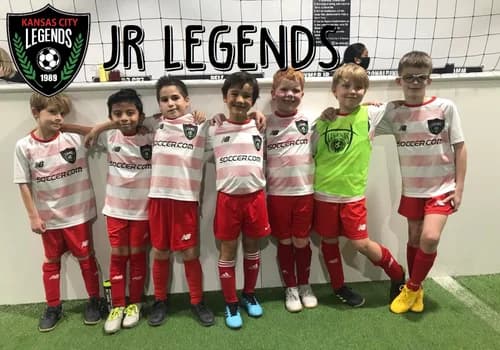
Ages 4-7 (Recreational/Introduction): City rec leagues, KC Legends Jr. Legends, or similar introductory programs. Focus: fun, movement, ball familiarity. One practice and one game per week.
Ages 8-10 (Development): Transition from recreational to development-focused programs. Small-sided play (4v4, 7v7). Some families join club teams at this age; others stay in structured development programs. Focus: technical foundation, love of the game.
Ages 11-13 (Competitive Entry): Most serious players are now in club programs playing in Heartland or equivalent leagues. Training increases to 2-3 sessions per week. Tournaments become part of the calendar. Focus: technical refinement, introduction to tactics, building competitive habits.
Ages 14-16 (Competitive Development): Players on a college track are competing at upper-division Heartland, ECNL, or MLS NEXT. College recruiting begins — coaches start watching at U15 showcases. Focus: tactical understanding, physical development, position-specific training.
Ages 17-18 (College Preparation): Active recruiting period. Players attend showcases, send film to college coaches, and make official/unofficial visits. High school soccer provides additional visibility in some states. Focus: refining the complete player, managing the recruiting process.
The numbers: According to the NCAA, approximately 7.9% of high school soccer players go on to play at some level of college soccer. For Division I, that number drops to about 2.4%. These are competitive odds, and families should go in with realistic expectations.
At KC Legends: We help families navigate this pathway at every stage. Our coaching staff includes former college players and coaches who understand the recruiting process. Visit our programs page for details on our competitive pathway.
How Kansas City Is Different from Coastal Markets
KC's youth soccer ecosystem has distinct characteristics compared to markets like Southern California, the Bay Area, the DC/Maryland/Virginia corridor, or the New York metro.
Advantages of being in Kansas City:
-
Lower travel burden. In Southern California, a "local" league game might require a 90-minute drive through traffic. In KC, most Heartland games are within 30 minutes. This is a genuine quality-of-life advantage for families.
-
Facility quality. The Scheels complex is one of the best in the nation. Many coastal markets have superior talent pools but worse infrastructure — overbooked fields, poor maintenance, and limited turf availability.
-
Cost. While soccer is expensive everywhere, KC's costs are 20-30% lower than equivalent programs in coastal markets. A competitive club season in the DC/Maryland/Virginia corridor routinely exceeds $5,000-$6,000 in club fees alone.
-
Community. The KC soccer community is tight-knit enough that coaches know each other, clubs have relationships, and families build genuine connections across teams.
Challenges:
-
Smaller talent pool. Coastal markets simply have more players, which means deeper competition at every level. A Gold-division team in KC Heartland might be Silver-equivalent in a Maryland or North Texas league.
-
Less college coach visibility. College coaches concentrate their recruiting travel in talent-dense markets. KC players who want D1 attention need to attend national showcases rather than relying on being seen at local events.
-
Weather limitations. From December through February, outdoor training in KC is unreliable. Clubs without indoor facilities lose critical development weeks to weather cancellations. This is a real competitive disadvantage versus year-round outdoor markets.
What Parents Should Watch For
Based on the data and our experience working with families in the KC metro, here are the trends we think thoughtful parents should be paying attention to:
Early specialization pressure. The data is clear: children who specialize in a single sport before age 12 are more likely to burn out, more likely to get injured, and no more likely to reach elite levels than multi-sport athletes. If your child's club is pressuring you to quit other sports at age 9, that is a red flag.
Coaching quality over club prestige. The single most important factor in your child's development is the quality of their day-to-day coach — not the club name on the jersey. A great coach at a smaller club will develop your child better than a mediocre coach at a big-name program.
Playing time matters more than division level. A player who gets 80% of minutes in a Silver division will develop faster than a player who gets 30% of minutes in Gold. If your child is not playing, they are not developing — regardless of how strong the team is.
Long-term over short-term. The best development programs prioritize where a player will be at 17 over where they are at 12. Early results are a poor predictor of long-term outcomes. Trust the process over the scoreboard.
Frequently Asked Questions
Q: How many youth soccer clubs are there in Kansas City? A: The KC metro is home to more than 30 youth soccer clubs across Kansas and Missouri, ranging from small community-based organizations to nationally competitive programs. The exact number fluctuates as clubs merge, rebrand, or new organizations form.
Q: Is youth soccer participation growing in Kansas City? A: Youth soccer participation in the KC metro has been stable to slightly growing over the past five years. Nationally, US Soccer reports approximately 3.9 million registered youth players. Kansas City's participation rate per capita is above the national average, supported by strong infrastructure and Sporting KC's visibility.
Q: What percentage of youth soccer players play in college? A: According to the NCAA, approximately 7.9% of high school soccer players go on to play college soccer at any level (D1, D2, D3, NAIA, junior college). For Division I specifically, about 2.4% of high school players earn a roster spot. These numbers underscore the importance of enjoying the journey rather than banking everything on a college scholarship.
Q: Why is youth soccer so expensive? A: The primary cost drivers are facility rental and maintenance, coaching salaries (as clubs hire more full-time professional coaches), tournament entry and travel, and equipment. The shift toward year-round play has also increased costs by extending the season from 8-9 months to 11-12 months. Financial aid and scholarship programs exist at many clubs, including KC Legends.
Q: What age should my child start playing soccer? A: Children can start introductory soccer programs as early as age 3-4, but structured competitive play should wait until age 9-10 at the earliest. The U.S. Soccer Development Model recommends emphasizing free play and basic movement skills for children under 6, with progressive structure added from ages 6-10.
Q: Is it better to play on a winning team or get more playing time? A: Playing time wins, every time. Player development research consistently shows that accumulated minutes of quality play are the strongest predictor of long-term improvement. A player who sits the bench on a championship team develops slower than a player who plays every minute on a mid-table team.
Q: How does KC Legends fit into the Kansas City soccer landscape? A: KC Legends offers programs from recreational 4v4 leagues through competitive academy teams that play in Heartland Soccer Association. Our focus is player development — building technically skilled, tactically intelligent players through a structured curriculum. We serve the full spectrum from first-time players to competitive athletes. Learn more on our programs page.
The Bottom Line
Youth soccer in Kansas City is in a strong position. The infrastructure is excellent, the club options are deep, and the pathways from recreational to competitive to college are well-established. But the landscape is also complex, expensive, and sometimes confusing for families navigating it for the first time.
The best thing you can do as a parent is stay informed, ask good questions, focus on your child's enjoyment and development rather than results, and choose a club that aligns with your family's values and goals.
If you want to learn more about how KC Legends approaches player development, or if your child is ready to try out for a competitive team, we would love to have a conversation. We are building something different here — and the data says that different approach works.
Topics